
| Reviews & Columns |
|
Reviews DVD TV on DVD Blu-ray 4K UHD International DVDs In Theaters Reviews by Studio Features Collector Series DVDs Easter Egg Database Interviews Feature Articles Columns Anime Talk DVD Savant Horror DVDs The M.O.D. Squad Art House HD Talk Silent DVD
|
 DVD Talk Forum |
|
|
|
Columns

|
|
|
Boccaccio '70
Glenn Erickson
At the height of the craze for European art films when Federico Fellini and Michelangelo Antonioni were in peak form, super-producer Carlo Ponti dreamed up this omnibus opus, four lengthy short subjects each directed by a major talent. Clocking in at a whopping three hours and eighteen minutes, American importer Joseph E. Levine immediately lopped off Mario Monicelli opening episode, leaving a more easily distributed film by the three directors with bigger reputations among New York critics: Federico Fellini, Luchino Visconti and Vittorio De Sica.
Most American viewers have only seen Boccaccio '70 in this tryptich form, and usually pan-scanned in faded Television prints. The new DVD outfit NoShame Films (Yesterday, Today and Tomorrow) gives us this interesting landmark production at its full length, uncut, and in a brightly-colored transfer.
The American trailer for Boccaccio '70 tries to explain that the title refers to what Boccaccio would come up with if he were to make a film in 1970; in other words, it's meaningless. What we get are four rather good mini-movies by top Italian filmmakers. There was some talk of Mario Monicelli's episode not fitting in with the others, but the obvious reason it was dropped from international distribution was to cut down the length of the film. If Monicelli's show seems different, it's because the other three each have a more exploitable sex element. The producer's natural favorite Sophia Loren does yet another of her big-tease-but-no-payoff farces, Romy Schneider provides some discreet but intoxicating near-nudity, and Anita Ekberg sends up her bosomy bombshell image from La Dolce Vita by appearing as a literal mountain of flesh, a Colossus of Sex.
Each episode presents a different facet of Italian art filmmaking of the time. Mario Monicelli's tale of frustrated newlyweds is a Neorealist exercise, sketching the day-to-day reality of love oppressed by economic concerns. Renzo and Luciana have to sneak across town to marry on a work break. As they can't afford a place of their own, the pair spend a miserable honeymoon surrounded by curious children and insensitive adults. If they want a drink when they dance, they should probably walk home. And all the while they must put up with the unwanted advances of Luciana's loutish office supervisor.
Monicelli's episode is handsomely produced and needs make no excuses, but viewers will probably be anxious to get on to the big names and sexy actresses of the later chapters. The chopping of this section by Joe Levine invites comparison with the Japanese horror omnibus Kwaidan. It was shorn of an entire chapter for American art houses as well. That spirit lived on in the Miramax company's routine editing of their foreign imports of the last fifteen years - Like Water for Chocolate, Italian for Beginners, etc.
The most famous episode is Federico Fellini's The Temptation of Dr. Antonio, the "1/2" in 8 & 1/2. Here's the first time we see Fellini's "crazy circus" filming style in all its glory, as Nino Rota's bouncy, maddening jingle Bevete più latte ("Drink more milk") provides the music for the mad parade of boy scouts, schoolgirls, nuns, firemen, jazz musicians and ordinary citizens that rallies around the giant billboard of "Anita" holding a glass of milk in a seductive pose. Fellini is taking time out from 'meaningful' epics to have a bit of fun and doesn't mind pulling in references from Frank Tashlin (remember Ekberg's mammary competition Jayne Mansfield holding the milk bottles in the suggestive cartoon The Girl Can't Help It?) and of course American science fiction films with Allison Hayes and Dorothy Provine as fifty-foot females on the prowl. Ekberg becomes the monstrous incarnation of the prudish Dr. Antonio's repressed desires - his 'enemy' is at one point revealed to be a lost mommy figure. Antonio is indulged and tolerated by even his conservative friends and Church officials also consider him a pest; he's as alone as the figure of St. George slaying the dragon that hangs on his wall. The episode is unique, highly enjoyable, and shows Fellini at his fun-loving best.
The most profound episode is Luchino Visconti's Il lavoro, a deft and thoughtful one-act that's modest in production value. The devastatingly beautiful Romy Schneider is the center of the show, before her dilution in comedies like What's New Pussycat? She totally eclipses Thomas (Tomas) Milian, who would later become a fixture in political Spaghetti westerns. This chapter makes a Boccaccio-esque comparison between a wife and a whore, as Schneider's pampered frau discovers her real place in her fairy-tale of a marriage. The husband whines and pleads for his straying to be ignored and his allowance untouched, which prompts Schneider to put him to the test. It's all conveyed through costume changes and elaborate 'business' in their palatial home, with servants serving food, starting baths and rounding up Schneider's collection of kittens. She acts nonchalant and teases her insolent hubby with her body, while revealing several layers of inner disillusion and disappointment. Visconti pulls off an almost perfect character analysis, without the grandiose trappings of his other masterpieces (Senso, The Leopard, The Damned) . Schneider's wife never says explicitly what she has in mind but her crushed, rueful look when Milian thoughtlessly falls into her trap expresses much more. It's a masterful sequence that sums up A Doll's House in just a few telling moments.
The final chapter is a light comedy in Vittorio De Sica's 'down in the streets' mode. If I were Italian I might wonder just how condescending is the director's typing of common folk as mostly sweet but crude buffoons. Sophia Loren's unlikely gutter princess is just another side of beef in a stockyard fair, the grand prize in a blind raffle. Prospective lechers of all shapes and sizes show up to "see the goods" as if they were inspecting a prize heifer. In an inspired bit of sex-play, the writers contrive to make Loren remove her red blouse so as not to arouse a mad bull. The bull calms down but the assembled Italian cowpokes are aroused en masse by the sight of the star's (obviously custom-fit) underwear. As in a number of other sex farces with Ms. Loren the episode has to be all tease. Events conspire to make sure that the meek churchgoer with the winning ticket doesn't collect his prize, and that the naughty girl's profits are returned, etc. The fun here will depend greatly on one's attraction to Italy's sex symbol; there are some cute Rock 'n Roll and cha-cha riffs on the soundtrack. Loren sings a song called "Money Money Money" to round out the package.
Showing up in various bits throughout the show are name actors Suso Cecchi d'Amico, Paolo Stoppa (practically a cameo) and Romolo Valli; the amusing gallery of sad sacks in La Riffa are said to be non-professionals.
NoShame's DVD of Boccaccio '70 is a fine-looking enhanced transfer wisely spread across two discs to maintain an optimal bit rate. The cheesy Joe Levine American titles are saved for an extra; the print on view has classy Italian originals with titles and curtains announcing Atto 1, Atto 2 and so forth. Savant didn't measure and cannot say for sure, but the show appears to be a PAL transfer converted to NTSC. It's a good job, but some of the chatter-talk in episode one feels fast. I wasn't particularly aware of the 1-frame speed-up anywhere else, but I'm not all that familiar with the film or its music, except for the Rota theme in the Fellini episode. If it's sped-up, it fooled me.
The handsome music on Il lavoro is by Rota as well, and the disc's clear audio makes it sound equally attractive.
Extras include extensive still and art galleries (some of the stills aren't that well encoded), the Italian trailer and Joe Levine's import trailer, and a booklet with liner notes and a duplicate of the U.S. pressbook. There is also some brief behind the scenes archival footage of De Sica filming Loren for the final episode.
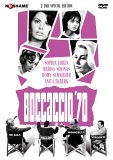
NoShame's presentation uses original poster art for the cover. Syntax and usage errors make it look as though a non-English language native wrote the package text copy. This is a very attractive disc of a fairly hard-to-see European classic.
On a scale of Excellent, Good, Fair, and Poor, Boccaccio '70 rates:
Movie: Excellent
Video: Excellent
Sound: Excellent Italian (Dolby Digital 2.0 Mono), English (Dolby Digital 2.0 Mono)
Supplements: Poster and still gallery, including photos from backstage and the U.S. premiere; U.S. theatrical trailer; Italian theatrical trailer; Archival footage; Original U.S. main titles; booklet with liner notes and reprint of the original U.S. press book
Packaging: Two discs in Keep case
Reviewed: April 20, 2005
| |
|


| Popular Reviews |
| Sponsored Links |
|
|
| Sponsored Links |
|
|
| Release List | Reviews | Forum | Blu-Ray | Advertise | |||
|
Copyright 2026 DVDTalk.com All Rights Reserved. Legal Info, Privacy Policy, Terms of Use,
Manage Preferences,
Your Privacy Choices 
| |||||||