
| Reviews & Columns |
|
Reviews DVD TV on DVD Blu-ray 4K UHD International DVDs In Theaters Reviews by Studio Features Collector Series DVDs Easter Egg Database Interviews Feature Articles Columns Anime Talk DVD Savant Horror DVDs The M.O.D. Squad Art House HD Talk Silent DVD
|
 DVD Talk Forum |
|
|
|
Columns
  

 
|
|
|
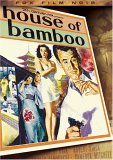
House of Bamboo
The Fox Film Noir collection adds a prime Sam Fuller title to its list of thrillers with House of Bamboo, a uniquely weird crime story that represents the high point of the director's relationship with Darryl F. Zanuck. Fuller proposed a movie set in Russia that Zanuck turned down, only to be offered the dream assignment of shooting the company's first picture in Japan, only ten years after the end of the war. He came up with an adaptation of the earlier noir, The Street with No Name, combining it with an idea he had for a gang of crooks who plot their crimes with military planning strategies. Beautiful CinemaScope photography in the streets of Tokyo lends the completed film a needed air of authenticity, because in almost every other respect the story premise is absurd.
Comic-book gangster business mixes with an exotic setting for an undeniably bizarre picture; Sam Fuller's dynamic direction made him the darling of the French Cahiers du Cinema critics.
What's wrong with this picture? In the middle fifties Americans were assured that Japan was a completely pacified nation with almost no crime and few weapons in civilian hands. American visitors would feel safer on the streets of Tokyo than they might in their own home towns.
By and large that picture was true, but according to other sources Japan was giving birth to a thriving new Yakuza underworld that controlled gambling and vice through organized crime very similar to the American model.
House of Bamboo puts forward the amazing conceit that a gang of American criminals, most of whom do not speak the language, could operate Pachinko parlors while carrying out wild-west style armed robberies, holdups and murders right in the middle of Tokyo. Anyone familiar with a later films like Battles without Honor and Humanity will immediately realize that Robert Ryan's Sandy and his pushy crew would be turned into sushi the first time they tried any muscle business on Yakuza turf. Surely there were plenty of black market crimes involving service men and perhaps a few ex-servicemen, but the idea of Gangland USA operating on the Tokyo streets is comic-book stuff.
Sam Fuller's script is an ex-soldier's escapist fantasy, an occupation daydream. Sandy and his men all have mistresses they call "kimonahs," (sic) pliant Japanese beauties who do the Lindy Hop when not serving formal tea. This would seem to be the reward for victory - breakfast in bed with a smiling Japanese "kimonah." No wonder Fuller alluded to protests following his film crews on the streets of Tokyo. He mentions the protesters scattering when he turned his cameras on them - the occupation was officially over (or nearly over) but the fear of arrest must have been real.
Of course Sam Fuller had no intention of insulting the Japanese, quite the opposite. In its own way his film shows respect for the nation and at least acknowledges that there is a separate culture worth appreciating. The interesting thing is that any other director would realize how ridiculous the premise was, while Sam just saw a great story in an exotic locale and proceeded to make one of his most exciting and interesting pictures.
Robert Stack's Spanier character stomps through Tokyo like a thorough Ugly American, yelling at people for not speaking English and roughing up Pachinko operators (later revealed to work under American gangster bosses) before connecting with cool operator Sandy. Fuller's style might be called comic book/travelogue/graphic. At one point Spanier walks a complicated path of gangplanks between some boats on a canal, ostensibly to ask some questions but really to show off the undeniably authentic location. He tries to find Mariko, the widow of an American gangster (Shirley Yamaguchi), and finds a kabuki troupe rehearsing on the roof of their theater. The obvious reason why they're up there in the cold is to get the color and costumes out into the daylight for a dynamic trucking shot, and to avoid an interior lighting situation in Tokyo - most of the interiors seem to have been shot back on the Fox lot in Los Angeles. Spanier meets Sandy in a nifty reveal when Cameron Mitchell knocks him through a CinemaScope-shaped paper screen. The entire gang is waiting on the other side.
With the trip to Japan the film's one fiscal extravagance, Fuller cut corners where possible. Most of Sandy's gang do not appear on the Tokyo locations and probably never left Hollywood, although Cameron Mitchell is seen outside a castle moat and Robert Ryan definitely shows up for the finale. A second look at the picture is required to catch all of the Japanese locations matched (presumably) with California stage settings.
It appears that critic-turned-director Jean-Luc Godard used Eddie Spanier as a behavorial model for his take on the Lemmy Caution character in Alphaville ten years later. Both secret agents are strangers stalking through an alien culture with contempt for most everything they see, at least until an attractive skirt catches their eye.
House of Bamboo traces themes through decades of crime films. Sandy hands over a wad of bills for Spanier to use to buy a new suit. "I like my boys to look sharp," says Sandy, a line that echoes Little Caesar while also introducing a screwy homoerotic theme to Sandy's obvious psychosis. Other scenes, like the execution of a wounded comrade during a getaway and the way a train robbery is blocked with the thieves attacking from beneath a railroad overpass, point forward to The Wild Bunch, a movie that blends Western and Gangster mythology.
The movie pays off with two kinds of spectacle. Fuller stages a (for 1955) wild shootout at a fascinating kiddie playground atop a multi-story department store, which was owned by Nikkatsu of movie studio fame (according to Fuller's autobiography). A giant ride at the very top suspends the little kids eight or ten floors above the street, which seems like insanity to this parent. But it makes a unique location for a final duel. Besides Fuller's realistic use of bullet impacts and stereophonic sound effects, the globe-shaped ride harkens back to the "Top of the World" theme from White Heat or the various mentions of "Cook's Tours" and "See the World" in the earliest of gangster films.
An even more sensational pre-climax is the culmination of the Sandy Dawson mania. It may have been invisible to all the actors save Robert Ryan, as Fuller claims, but Sandy's preferential attraction to Robert Stack couldn't be more obvious. Sandy asks his whole gang why he broke his own rule and saved Spanier, while Griff looks hurt and jealous in the background. Sandy's military obsession is shown to be just one facet of his psychosis, as he takes personal charge of Spanier and makes it his business to supervise Spanier's kimono Mariko, as if she were his proxy. With Robert Stack playing most of his scenes with the same blank stare, this is Robert Ryan's film all the way.
(spoiler)Finally, Sandy's mistaken revenge against a squealer results in just about the kinkiest violence ever in a film noir - he bursts into a Japanese bath and without pause empties six shots through a wooden bathtub. Then he gently lifts the head of the man he's just killed and explains why it was necessary. Even today, the scene is so jolting it often gets an unintentional laugh, an audience defense mechanism against the outlandishness of it all. Fuller's staging and Ryan's performance in the one-shot scene are remarkable.
Shirley Yamaguchi is said to have been a Boston resident and accomplished actress; House of Bamboo teems with other notables in roles large and small. Cameron Mitchell (Blood and Black Lace) is excellent considering that Fuller never really gives him a closeup, and the same goes for DeForest Kelley's unbilled henchman Charlie, he of the wicked grin and smart remark. Brad Dexter (The Magnificent Seven) is colorless as the military policeman and Sessue Hayakawa (Bridge on the River Kwai) has almost nothing to do as his opposite number in the Tokyo police. Members of Sandy's gang without dialogue include Robert Quarry (Count Yorga, Vampire), Biff Elliott (I, The Jury), John Doucette and Harry Carey Jr.. Mariko's uncle is played by Teru Shimada, the industrialist Osato in the much later You Only Live Twice.
Something happened to the Darryl Zanuck/Sam Fuller relationship after House of Bamboo; the abortive Tigrero! project fell through and Fuller once again became an independent, making remarkable but only moderately successful pictures for the next several years. 1 It was at this time that he says he conceived his epic war film The Big Red One, which was eventually shot on a dime-store scale 25 years later. Only with Merrill's Marauders for Warners would he finally be given the ability to do one of his personal combat films on an appropriately grand scale.
House of Bamboo is a truly eccentric fantasy of American crooks in a Japanese millieu. For credibility it's only a few notches above the bizarre Cold War comic of Hell and High Water (another loony Savant favorite) but still presents us with an engaging group of characters. And watch out for that bathtub!
Fox's DVD of House of Bamboo is a visual stunner, with Joe MacDonald's decorative cinematography finding color in every scene - the film was reportedly shot during a cold Tokyo winter. The enhanced transfer is a vast improvement over TV broadcasts and the splicy 16mm print that made an American Cinematheque audience furious back in 1997 or so. The disc retains the film's original 4 channel stereo, plus a mono Spanish and French track; Fox's audio department did good work beefing up Fuller's brief action scenes - he was one director who really knew what the middle of a gunfight sounded like!
On a scale of Excellent, Good, Fair, and Poor, House of Bamboo rates:
Movie: Very Good
Video: Excellent
Sound: Excellent
Supplements: Trailer, Spanish Trailer, newsreels, Commentary by Alain Silver and Jim Ursini
Packaging: Keep case
Reviewed: May 27, 2005
Footnote:
1. Correction & detail from "B", 5-27-5: Dear Glenn: Fuller and Zanuck didn't really have a falling out. DFZ left the helm of Fox in 1956 to go into independent production. Fuller, who was nonexclusive to Fox even while he was making films at the studio, then went basically independent as well -- while Fox financed and distributed his 1957 Forty Guns and China Gate, both were actually produced by Fuller's Globe Enterprises. Run of the Arrow and Verboten! were produced by Globe Enterprises for RKO; The Crimson Kimono and Underworld U.S.A. were Globe Enterprises productions for Columbia. While Fox controls the rights to Forty Guns, Republic seems to currently possess the rights to China Gate.
Return
| |
|



| Popular Reviews |
| Sponsored Links |
|
|
| Sponsored Links |
|
|
| Release List | Reviews | Forum | Blu-Ray | Advertise | |||
|
Copyright 2026 DVDTalk.com All Rights Reserved. Legal Info, Privacy Policy, Terms of Use,
Manage Preferences,
Your Privacy Choices 
| |||||||